

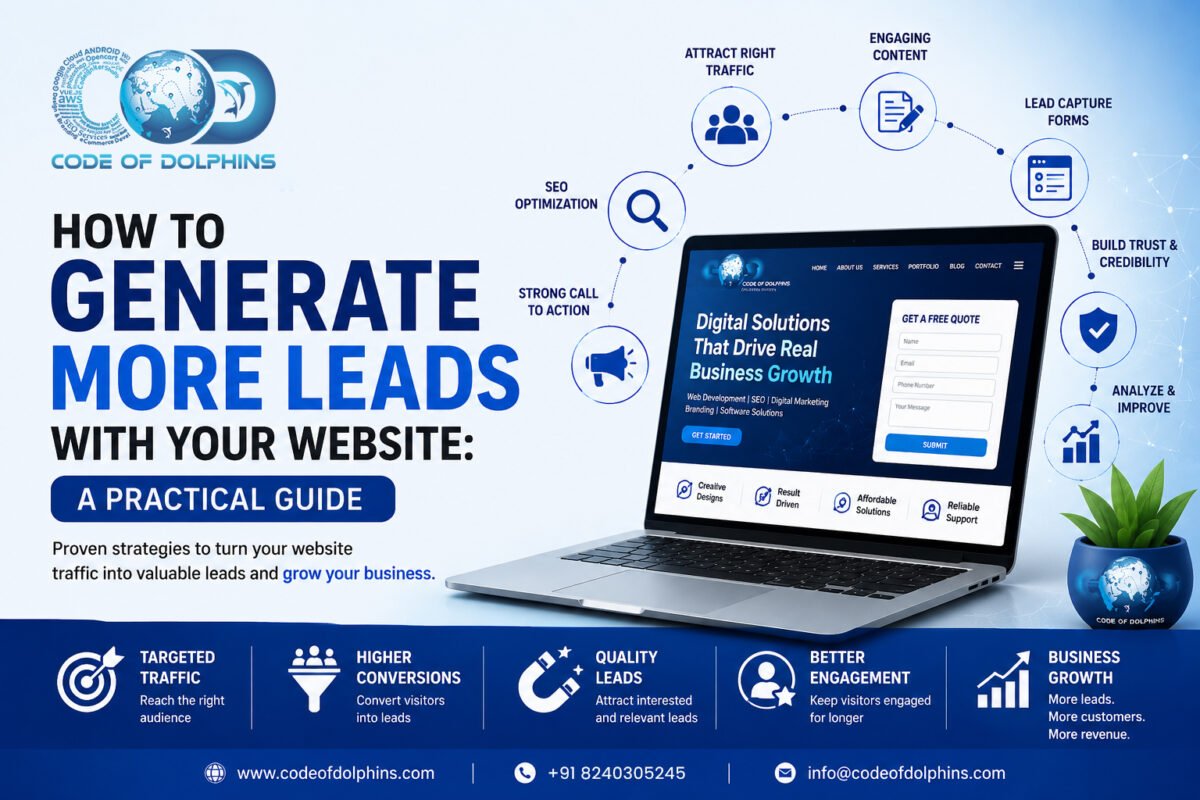
Your website should be more than a digital brochure. It should be your hardest-working salesperson, capturing interest and converting visitors around the clock. Yet most websites convert fewer than 3% of their visitors into leads. If your traffic is growing but your inbox stays quiet, the problem usually isn’t your product; it’s how your website asks for the conversion.
This guide walks through the most effective ways to generate more leads with your website, from quick wins you can implement this week to longer-term strategies that compound over time.
Start with a Clear Value Proposition
Visitors decide within seconds whether your site is worth their time. Your homepage headline should answer three questions immediately: what you offer, who it’s for, and why it’s better than the alternatives. Vague slogans like “Innovative solutions for a digital world” cost you leads. Specific promises like “Bookkeeping software that saves small businesses 10 hours a month” earn attention and clicks.
Test your value proposition by showing your homepage to someone unfamiliar with your business for five seconds. If they can’t tell you what you do and why it matters, rewrite it.
Place Strong Calls-to-Action Above the Fold
A call-to-action (CTA) is the bridge between visitor interest and lead capture. The most common mistake is burying a single “Contact Us” link in the footer. Instead, place a prominent, benefit-driven CTA above the fold on every key page. “Get Your Free Audit” outperforms “Submit” because it tells visitors exactly what they’ll receive.
Use contrasting colors so the button stands out, keep the copy action-oriented, and repeat the CTA naturally as the page scrolls. Different pages can carry different CTAs: a pricing page might push “Start Your Free Trial,” while a blog post might offer a related downloadable guide.
Create Lead Magnets Worth Trading an Email For
Nobody hands over their email address for nothing. A lead magnet is a valuable resource offered in exchange for contact information, and its quality directly determines your conversion rate. Effective lead magnets solve one specific problem quickly: a checklist, a template, a calculator, a short email course, or an industry benchmark report.
The best lead magnets align with buying intent. Someone downloading “The Complete Guide to Choosing a CRM” is far closer to a purchase than someone grabbing a generic ebook. Map your lead magnets to different stages of the buyer journey so you capture both early researchers and ready-to-buy prospects.
Build Dedicated Landing Pages for Every Campaign
Sending paid traffic to your homepage is one of the fastest ways to waste money. A dedicated landing page focuses on a single offer with a single CTA, removing navigation menus and distractions that leak visitors away. Companies with 10 to 15 landing pages see roughly 55% more leads than those with fewer than 10.
Every landing page needs a headline that matches the ad or email that brought the visitor there, social proof such as testimonials or client logos, a short benefit-focused pitch, and a form. Message match matters: if your ad promises a free consultation, the landing page should say “free consultation” in the headline, not something generic.
Shorten and Simplify Your Forms
Every extra form field lowers your conversion rate. For a top-of-funnel lead magnet, name and email are usually enough. Save qualifying questions like company size or budget for later in the relationship, or use progressive profiling that asks for new information over multiple interactions.
If your sales team genuinely needs more fields, test a two-step form: the first step asks an easy, low-commitment question, and the second collects contact details. Momentum from the first click significantly increases completion of the second step.
Use Live Chat and Chatbots to Capture Intent in Real Time
Many high-intent visitors have one blocking question, and if they can’t get an answer quickly, they leave. Live chat and AI chatbots let you answer that question in the moment and capture contact details in the process. Chatbots can qualify visitors after hours, book meetings directly onto your sales calendar, and route hot leads to a human instantly.
Keep the experience helpful rather than pushy. A chat prompt that appears after 30 seconds on your pricing page (“Have questions about which plan fits your team?”) converts far better than an aggressive popup on arrival.
Attract Qualified Traffic with SEO and Content
Lead generation math is simple: conversion rate multiplied by traffic. Content marketing and search engine optimization bring in visitors who are already searching for what you offer, which makes them dramatically easier to convert. Target keywords with commercial intent, such as “best [your category] for [audience]” or “[competitor] alternatives,” alongside informational topics that build trust earlier in the journey.
Within each article, include contextual CTAs that match the topic. A post about email marketing mistakes should offer an email audit checklist, not a generic newsletter signup. Internal links should guide readers from informational content toward your highest-converting pages.
Add Social Proof Everywhere Decisions Happen
Trust is the invisible barrier between a visitor and a form submission. Testimonials, case studies, review scores, client logos, and concrete results (“helped 400+ agencies cut reporting time in half”) all reduce perceived risk. Place social proof next to CTAs and forms, where hesitation peaks, rather than isolating it on a separate testimonials page nobody visits.
Specific proof beats generic praise. “Increased our demo bookings by 42% in three months” is more persuasive than “Great company, highly recommend.”
Recover Abandoning Visitors with Exit-Intent Offers
Most visitors leave without converting, but exit-intent popups give you one last chance. When the cursor moves toward the browser bar, trigger an offer: a discount, a lead magnet, or simply a question like “Want us to send you this guide for later?” Used sparingly and with a genuinely useful offer, exit-intent popups can recover 2 to 4% of abandoning traffic, which adds up quickly at scale.
Pair this with retargeting ads so visitors who leave still see your brand as they browse elsewhere, keeping the door open for a return visit.
Measure, Test, and Iterate
Lead generation is never finished. Install analytics and heatmap tools to see where visitors drop off, then run A/B tests on headlines, CTA copy, form length, and page layout. Small improvements compound: lifting a landing page from 2% to 3% conversion is a 50% increase in leads with zero additional traffic spend.
Review your funnel monthly. Which pages bring in traffic but capture no leads? Which lead magnets attract subscribers who never buy? Let the data direct your next experiment.
Final Thoughts
Generating more leads with your website comes down to three things: attracting the right visitors, giving them a compelling reason to share their contact information, and removing every ounce of friction from the process. Start with the fundamentals, a clear value proposition, strong CTAs, and one great lead magnet, then layer in landing pages, chat, SEO, and testing as you grow.
You don’t need to implement everything at once. Pick the tactic that addresses your biggest leak, ship it this week, and measure the result. Consistent iteration beats a perfect plan every time.
