Drag

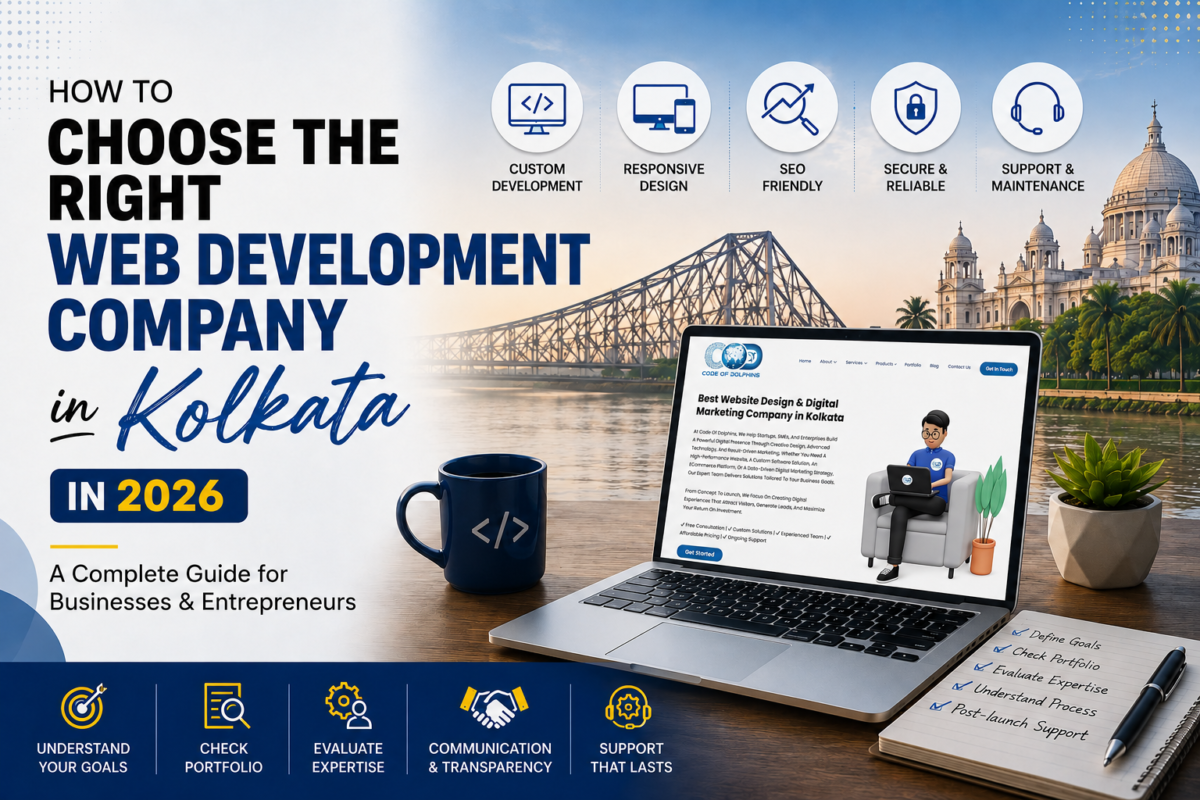
How to Choose the Right Web Development Company in Kolkata in 2026

Choosing a web development company in Kolkata should be simple. There are hundreds of agencies and freelancers in the city, all promising a “stunning, modern website.” Yet ask any business owner who has been through the process, and you’ll hear the same stories: projects that dragged on for months, websites that looked fine but never appeared on Google, developers who disappeared the moment the final invoice was paid.

The problem isn’t a shortage of developers. It’s that most businesses don’t know how to evaluate one before signing a contract.

Your website is usually the first interaction a potential customer has with your business. In 2026, it’s also what AI search tools, Google, and mobile users judge you by — often before they ever call you. A poorly built website doesn’t just look bad; it silently loses leads every single day.

This guide walks you through exactly how to choose the right web development company in Kolkata: what a professional agency should actually deliver, the ten things to verify before hiring, the questions to ask, how pricing works, and the mistakes that cost businesses the most.

Key Takeaways

  • A website is a business asset, not a design project — evaluate developers on business outcomes (leads, speed, search visibility), not just visuals.
  • Always review a company’s live portfolio and test those websites yourself on mobile before believing any claims.
  • SEO, page speed, mobile responsiveness, and security must be built in during development — retrofitting them later costs far more.
  • Custom development and template-based websites both have valid use cases; the right choice depends on your budget, timeline, and growth plans.
  • Website development cost in Kolkata varies widely based on scope — always request a detailed, itemised quotation instead of comparing lump-sum prices.
  • Post-launch support and maintenance matter as much as the build itself; confirm them in writing.
  • A local Kolkata-based partner offers easier communication, in-person meetings, and better understanding of the regional market.

Why Choosing the Right Web Development Company Matters

The right web development company determines whether your website becomes a growth engine or an expensive digital brochure. That’s the honest difference.

Consider what actually depends on this one decision:

  • Your credibility. Visitors form an impression of a website within seconds. An outdated or slow site makes even an excellent business look unreliable.
  • Your search visibility. Google evaluates page speed, mobile experience, site structure, and code quality. These are development decisions, not marketing afterthoughts.
  • Your lead flow. A website built around clear user journeys and conversion points generates enquiries. One built purely for aesthetics doesn’t.
  • Your future costs. A badly coded website often has to be rebuilt from scratch within a year or two. Choosing well the first time is almost always cheaper.

For businesses in Kolkata specifically, the stakes are rising. Local customers increasingly search for services online — “interior designer near me”, “CA firm in Salt Lake”, “wholesale supplier Burrabazar” — and the businesses that show up with fast, professional websites win those enquiries. The rest are invisible.

What Does a Professional Web Development Company Actually Do?

A professional web development company plans, designs, builds, tests, launches, and maintains websites and web applications that serve specific business goals. It’s much more than writing code. Here’s what a full-service website design and development company should cover.

Website Design and UI/UX

Design is about how a website works, not just how it looks. Good UI/UX design maps out how a visitor moves from landing on your homepage to contacting you or making a purchase. A professional team researches your audience, plans page layouts and navigation, and designs interfaces that reduce friction. If an agency starts talking about colours before understanding your customers, that’s a warning sign.

Frontend and Backend Development

The frontend is everything your visitor sees and interacts with; the backend is the engine behind it — databases, server logic, content management, and integrations. A capable company works with modern, well-supported technologies (for example, PHP and Laravel, React.js, Node.js, WordPress, or Shopify depending on the project) and can explain why a particular stack suits your requirements rather than defaulting to whatever they always use.

Mobile Responsive Development

The majority of web traffic in India comes from smartphones. Responsive website development means your site adapts seamlessly to every screen size — not a shrunken desktop site that requires pinching and zooming. In 2026, mobile-first design is the baseline: Google primarily indexes the mobile version of your website, so a poor mobile experience directly damages your rankings.

eCommerce Development

Selling online involves product catalogues, secure payment gateways, shipping and tax logic, inventory management, and order workflows. A company experienced in eCommerce website development can advise whether Shopify, WooCommerce, or a custom-built platform fits your product range, margins, and operations — and can integrate payment options Indian customers expect, such as UPI, cards, and net banking.

Web Application Development

Some businesses need more than a website — they need web applications: customer portals, booking systems, dashboards, CRMs, or internal management tools accessible through a browser. Web application development requires stronger engineering discipline around databases, security, user roles, and performance. If this is your requirement, verify the company has genuinely built applications, not just brochure websites.

Website Maintenance and Support

Websites are not “finished” at launch. Software updates, security patches, backups, uptime monitoring, content changes, and performance optimisation are ongoing needs. A professional web development company offers structured post-launch support — and puts it in the agreement, not just in conversation.

10 Things to Check Before Hiring a Web Development Company in Kolkata

Use this as your evaluation framework. A company that scores well across all ten is far more likely to deliver a website that actually works for your business.

1. Portfolio and previous projects. Don’t just scroll through screenshots — open the live websites they’ve built. Browse them on your phone. Check how fast they load. Look for projects similar to your industry or requirements. A portfolio of real, functioning websites tells you more than any sales pitch.

2. Technical expertise. Ask which technologies they work with and why. A strong team can discuss the trade-offs between, say, WordPress and a custom Laravel build for your specific case. Vague answers about technology usually mean outsourced or copy-paste development.

3. UI/UX capabilities. Ask to see their design process: wireframes, user flows, or prototypes from past projects. Design decisions should be explained in terms of user behaviour and conversions, not personal taste.

4. Mobile responsiveness. Open three of their recent projects on your smartphone. Is the text readable? Do menus work smoothly? Do forms function properly? This two-minute test filters out a surprising number of agencies.

5. Website speed and Core Web Vitals. Run their portfolio sites through Google PageSpeed Insights. Consistently slow websites indicate poor coding habits — oversized images, bloated themes, excessive plugins. Speed is both a ranking factor and a conversion factor, and it’s very hard to fix after launch.

6. SEO-friendly development. A website should be built for search visibility from day one: clean code, logical heading structure, crawlable navigation, proper URLs, optimised images, and schema markup. Ask directly: “What do you do during development to make the site SEO-friendly?” A professional answer covers structure and performance, not just “we add meta tags.”

7. Security practices. At minimum: SSL/HTTPS on every project, secure forms, regular updates, protection against common vulnerabilities, and a backup policy. For eCommerce and web applications, ask how they handle user data and payment security.

8. CMS and technology options. Will you be able to update content yourself? A good company builds on a CMS suited to your team’s skills — and trains you to use it. Be cautious of proprietary systems that lock you into one vendor forever.

9. Communication and project management. Ask who your point of contact will be, how often you’ll receive updates, and what tools they use to track progress. Projects rarely fail because of technology; they fail because of poor communication. A dedicated project manager is a strong positive signal.

10. Post-launch support and maintenance. Confirm what happens after the website goes live: bug-fix warranty period, maintenance plans, response times, and costs for future changes. Get it in writing.

Questions to Ask a Web Development Company Before Hiring

Take these questions into your first meeting. The quality of the answers matters as much as the answers themselves.

  • Can you show me live websites you’ve built for businesses similar to mine?
  • Who will actually work on my project — an in-house team or subcontractors?
  • What is your process from kickoff to launch, and how long will my project take?
  • Which technology or CMS do you recommend for my requirements, and why?
  • How do you ensure the website will be fast and mobile-friendly?
  • What do you do during development to make the website SEO-friendly?
  • Will I own the website, domain, hosting, and source code after full payment?
  • How do you handle content — do I supply it, or do you offer content writing?
  • What does post-launch support include, and what does it cost?
  • What happens if I need changes or new features six months after launch?
  • How do you handle delays, scope changes, and revisions?

One question deserves special emphasis: ownership. Ensure the domain is registered in your name, you receive full admin access, and the contract states that the website and its code belong to you after payment. Disputes over ownership are among the most common — and most avoidable — problems businesses face.

Custom Website Development vs Template-Based Website: Which Is Right for You?

A template-based website uses a pre-designed theme that is customised with your branding and content. A custom website is designed and coded specifically for your business from scratch. Neither is universally “better” — they solve different problems.

Template-based websites (typically on WordPress, Shopify, or similar platforms) are faster to launch and more affordable. For a small business that needs a professional online presence — services, about, contact, gallery — a well-implemented template site is often a smart, practical choice. The risks come from lazy implementation: bloated themes that slow the site down, generic designs identical to competitors, and limited flexibility when you want unique features later.

Custom website development costs more and takes longer, but everything is built around your requirements: unique design, only the features you need (which usually means faster performance), and the freedom to scale — custom booking flows, calculators, portals, or integrations with your business software. For eCommerce businesses with specific workflows, companies with strong brand requirements, or anyone needing a web application, custom development is usually the right investment.

A practical rule of thumb: if your website’s job is to present your business credibly, a professionally customised template can serve you well. If your website is a core part of how your business operates — selling, booking, managing customers — invest in custom web development. A trustworthy agency will recommend the option that fits your situation, not the one with the bigger invoice.

How Much Does Website Development Cost in Kolkata?

There is no single price for website development in Kolkata, because a website is not a single product. Costs vary significantly based on what you’re building, and any agency quoting a fixed price before understanding your requirements should make you cautious.

The main factors that determine cost:

  • Type and size of website — a five-page business website, a 50-product online store, and a custom web application are entirely different projects.
  • Number of pages and how much unique design each requires.
  • Design complexity — customised template vs fully bespoke UI/UX design.
  • CMS choice — WordPress, Shopify, or a custom-built admin panel.
  • eCommerce functionality — payment gateways, shipping logic, inventory, order management.
  • Custom features — booking systems, calculators, member areas, multi-language support.
  • API and third-party integrations — CRM, WhatsApp, payment providers, logistics partners, accounting software.
  • Web application requirements — user roles, dashboards, databases, and security layers.
  • Content and SEO requirements — content writing, on-page optimisation, schema markup.
  • Maintenance and support plans after launch.

Rather than asking “how much does a website cost?”, share your requirements in detail and request a customised, itemised quotation from each company you’re considering. An itemised quote lets you compare agencies fairly — you can see exactly what’s included, what’s excluded, and where quotes differ. Be especially wary of prices that seem too low; they usually exclude essentials like responsive testing, SEO fundamentals, or post-launch support, which then appear as “extras” later.

Why Businesses in Kolkata Should Invest in Professional Web Development

A professionally developed website pays for itself through the business it brings in. Here’s what the investment actually buys:

  • Credibility. Customers research before they buy. A polished, modern website signals a trustworthy, established business — especially important for service businesses where trust drives enquiries.
  • Better user experience. Clear navigation, fast pages, and mobile-friendly layouts keep visitors engaged instead of sending them to a competitor.
  • Search visibility. Professional development lays the technical foundation Google rewards, helping you appear when Kolkata customers search for what you offer.
  • Lead generation. Strategically placed contact forms, click-to-call buttons, WhatsApp integration, and clear calls-to-action turn visitors into enquiries around the clock.
  • Higher conversion potential. Small development decisions — form length, page speed, trust signals, checkout flow — measurably affect how many visitors become customers.
  • Mobile accessibility. With most Indian users browsing on smartphones, a mobile-first website ensures you never lose a customer to a broken mobile experience.
  • Scalability. A well-architected website grows with you: new pages, new products, new features — without a rebuild.
  • Security. Professional development protects your business data, your customers’ information, and your reputation.

For local businesses, there’s an additional advantage in working with a web development company in Kolkata itself: face-to-face meetings when needed, no timezone friction, easier communication in your preferred language, and a partner who understands the local market you’re selling to.

How Web Development and SEO Work Together

SEO is not something you “add” to a website after launch — the most important SEO work happens during development. This is one of the most misunderstood aspects of hiring a web developer, and one of the most expensive lessons businesses learn too late.

Here’s how development decisions directly shape search performance:

  • Site structure and navigation determine how easily Google discovers and understands your pages. A logical hierarchy — services organised into clear sections, sensible internal linking — helps both users and search engines.
  • Page speed and Core Web Vitals are ranking signals. Clean code, optimised images, efficient hosting, and disciplined use of plugins and scripts are development choices that decide whether your site loads in two seconds or eight.
  • Mobile responsiveness is fundamental because Google indexes the mobile version of your site first.
  • Crawlability — proper robots.txt configuration, XML sitemaps, and the absence of broken links or orphaned pages — ensures search engines can access everything you want ranked.
  • URL structure should be short, readable, and descriptive (/ecommerce-website-development rather than /page?id=847).
  • Heading hierarchy (one H1, logical H2s and H3s) helps search engines and AI systems understand what each page is about.
  • Schema markup — structured data for your organisation, services, FAQs, and articles — helps Google display rich results and helps AI search tools interpret your content accurately.
  • Image optimisation — compressed files, modern formats, descriptive alt text — improves both speed and image search visibility.
  • Clean, semantic code without unnecessary bloat makes every other SEO effort more effective.

The practical takeaway: choose a company that treats SEO as part of the engineering, not a checkbox. When development and SEO teams work together from day one — as they do in agencies offering both services under one roof — the website launches ready to rank instead of needing months of technical repairs first.

Why Choose Code of Dolphins for Web Development in Kolkata?

If you’re evaluating web development partners in Kolkata, Code of Dolphins is worth including in your shortlist — and we’d encourage you to apply every criterion in this guide to us as well.

Code of Dolphins is a Kolkata-based digital solutions company offering website design and development, web application development, business website development, and eCommerce website development, alongside the services that make a website succeed after launch: SEO, local SEO, social media marketing, PPC management, content marketing, and branding. For businesses with bigger requirements, our team also builds mobile apps (Android, iOS, React Native) and custom business software such as CRM, inventory, HR, and management systems.

That end-to-end scope matters for a practical reason discussed throughout this article: when the same team handles your development, design, and SEO, your website is built SEO-friendly, mobile-first, and conversion-focused from the first line of code — not patched up afterwards.

Our development team works with modern, widely supported technologies including Laravel, PHP, React.js, Node.js, WordPress, Shopify, and WooCommerce, and follows a structured process from discovery and planning through UI/UX design, development, quality assurance, deployment, and post-launch support. Every project gets transparent communication, a clear roadmap, and ongoing maintenance options — the same things this guide tells you to demand from any agency.

We work with startups, SMEs, and established companies across industries including healthcare, education, real estate, retail, manufacturing, hospitality, and eCommerce, with solutions tailored to each business’s goals rather than one-size-fits-all packages.

Final Checklist Before Hiring a Web Development Company

Before you sign anything, confirm you can tick every box:

  • Reviewed their live portfolio and tested at least three sites on mobile
  • Checked portfolio sites’ loading speed (e.g., via PageSpeed Insights)
  • Verified experience with projects similar to yours
  • Received a detailed, itemised written quotation
  • Understood which technology/CMS will be used, and why
  • Confirmed the website will be responsive and mobile-first
  • Confirmed SEO-friendly development practices are included
  • Discussed security measures (SSL, backups, updates)
  • Agreed on timeline, milestones, and revision policy
  • Identified your single point of contact
  • Confirmed in writing that you own the domain, website, and code
  • Agreed on post-launch support terms and costs
  • Read independent reviews or spoken to a past client

If a company hesitates on ownership, support, or an itemised quote, keep looking.

Frequently Asked Questions

How do I choose the best web development company in Kolkata?

Shortlist 3–5 companies, review their live portfolios on both desktop and mobile, test their sites’ loading speed, and ask each for an itemised quotation. Evaluate them on technical expertise, SEO-friendly development practices, communication, ownership terms, and post-launch support — not just design samples or price.

How much does website development cost in Kolkata?

Costs vary widely depending on the type of website, number of pages, design complexity, features, integrations, and support requirements. A simple business website costs far less than an eCommerce store or custom web application. Request a customised quotation based on your specific requirements rather than relying on generic price lists.

How long does it take to develop a business website?

A standard business website typically takes a few weeks from kickoff to launch, while eCommerce websites and custom web applications take longer depending on complexity. Timelines also depend on how quickly you provide content and feedback. Ask each company for a milestone-based schedule before starting.

What should I look for in a web development company?

Look for a proven live portfolio, relevant technical expertise, mobile-first and SEO-friendly development practices, transparent pricing, clear communication with a dedicated contact person, written ownership terms, and structured post-launch support and maintenance.

What is the difference between web design and web development?

Web design covers the visual and experiential side — layouts, colours, typography, and user experience (UI/UX). Web development is the engineering that makes the design function — frontend code, backend systems, databases, and integrations. A full-service website design and development company handles both.

Should I choose WordPress or custom web development?

Choose WordPress (or a similar CMS) if you need a professional business website or blog quickly and affordably, with easy content editing. Choose custom development when you need unique features, specific workflows, custom web applications, or maximum performance and scalability. A good agency will recommend based on your requirements, not their convenience.

Can a web development company also handle SEO?

Yes — and it’s often an advantage. Agencies that offer both web development and SEO services build technical SEO into the website from the start: clean structure, fast loading, mobile responsiveness, schema markup, and crawlable navigation. This avoids the common problem of launching a website that then needs months of SEO repairs.

Why is responsive web design important?

Because most Indian users browse on smartphones, and Google primarily indexes the mobile version of your website. A responsive website adapts to every screen size, keeping mobile visitors engaged and protecting your search rankings. A site that works poorly on mobile loses both customers and visibility.

How can I make my website SEO-friendly?

Ensure fast loading speed, mobile responsiveness, a logical site structure with clear headings, descriptive URLs, optimised images with alt text, an XML sitemap, schema markup, and quality content that answers what your customers search for. Most of these are development decisions — which is why SEO-friendly development matters from day one.

Does a website need ongoing maintenance?

Yes. Websites need regular software and security updates, backups, uptime monitoring, and performance checks. Without maintenance, sites gradually become slow, vulnerable to security issues, and outdated. Confirm maintenance options and costs with your web development company before launch.

Ready to Build a Website That Works for Your Business?

Choosing the right web development company in Kolkata comes down to asking the right questions and verifying real work — and now you have the complete framework to do exactly that.

If you’d like to see how Code of Dolphins approaches website design and development, we’re happy to walk you through our portfolio, discuss your requirements, and prepare a customised quotation — with no pressure and no obligation. Whether you need a business website, an eCommerce store, a web application, or a complete digital presence with SEO and marketing, our Kolkata-based team is ready to help.

Request a free consultation or call us to discuss your project. Let’s build a website that earns its keep.

How to Generate More Leads with Your Website (2026)

Introduction

Your website is open 24 hours a day, 7 days a week — but is it actually working while you sleep?

For most business owners, the honest answer is no. Traffic trickles in from Google, social media, and referrals, but very few of those visitors ever pick up the phone, fill out a form, or send an inquiry. The website looks fine. It just doesn’t convert.

Here’s the uncomfortable truth: a website that doesn’t generate leads isn’t a marketing asset — it’s a digital brochure sitting quietly in the corner of the internet. And in 2026, with Google prioritizing helpful, trustworthy, user-first content and experiences, an underperforming website doesn’t just cost you leads. It costs you visibility too.

The good news is that lead generation isn’t guesswork. It’s a system — a combination of website speed, mobile responsiveness, persuasive design, strategic calls-to-action, trust signals, and search engine optimization working together. When these pieces are aligned, your website becomes what it should have been from day one: your hardest-working salesperson.

In this guide, we’ll break down exactly how to generate more leads with your website — the strategy, the psychology, the technical foundations, and the tools to measure it all. Whether you’re a small business owner, a startup founder, a SaaS company, or a marketing manager tasked with improving conversion rates, this is your complete 2026 playbook.


Table of Contents

  1. Why Most Business Websites Fail to Generate Leads
  2. What Makes a High-Converting Website
  3. Importance of Website Speed
  4. Mobile Responsiveness
  5. SEO Optimization
  6. Landing Pages That Convert
  7. Call-to-Action Strategy
  8. Forms That Convert
  9. Trust Signals, Testimonials & Case Studies
  10. Live Chat and WhatsApp Integration
  11. Conversion Rate Optimization (CRO)
  12. Heatmaps and Analytics
  13. Google Search Console & Google Analytics
  14. Core Web Vitals
  15. AI Chatbots
  16. Local SEO
  17. Content Marketing & Blog Strategy
  18. Lead Magnets and Email Capture
  19. Website Security and SSL
  20. Website Maintenance
  21. Why Professional Design Matters
  22. Common Website Mistakes
  23. Future Trends in 2026
  24. Poor Website vs. High-Converting Website (Comparison Table)
  25. 20-Point Website Lead Generation Checklist
  26. FAQs
  27. Conclusion & Call to Action

Why Most Business Websites Fail to Generate Leads

Before we talk about solutions, let’s talk about the problem. Most websites don’t fail to generate leads because of one big mistake — they fail because of dozens of small ones that quietly add up.

Here are the most common reasons:

  • No clear purpose. The homepage tries to say everything at once, so visitors leave without understanding what to do next.
  • Slow loading speed. Every extra second of load time increases the chance a visitor bounces before the page even renders.
  • Poor mobile experience. With most traffic now coming from phones, a clunky mobile layout kills conversions instantly.
  • Weak or missing calls-to-action. If visitors don’t see an obvious next step, they won’t take one.
  • Generic, templated design. Visitors form trust judgments within seconds — a dated or generic-looking site quietly signals “not credible.”
  • No SEO strategy. A beautiful website nobody finds on Google generates zero leads, no matter how well it converts.
  • Forms that ask too much. Long forms with unnecessary fields create friction and scare off otherwise-interested prospects.
  • No trust signals. No testimonials, no case studies, no certifications — just claims with nothing to back them up.

Research from the Nielsen Norman Group has long shown that users decide whether to stay or leave a website within seconds of arriving, largely based on visual design and immediate clarity. A widely cited Google/SOASTA study found that as page load time goes from 1 to 5 seconds, the probability of a mobile visitor bouncing increases significantly. Individually, each of these issues chips away at your conversion rate. Together, they can make an otherwise well-marketed business practically invisible online.

Real-world scenario: Imagine a local HVAC company spending $2,000 a month on Google Ads. The ads are well-targeted and the click-through rate is solid. But the landing page takes six seconds to load, has no visible phone number above the fold, and the contact form has twelve fields. Result? A high ad spend with a trickle of leads — not because the marketing failed, but because the website couldn’t close what the ads opened.


What Makes a High-Converting Website

A high-converting website isn’t about being flashy. It’s about removing friction and building confidence at every step of the customer journey. The best lead generation websites share a few core traits:

Clarity of Purpose

Within five seconds, a visitor should know: What does this business do? Who is it for? What should I do next?

Speed and Performance

Fast websites keep visitors engaged long enough to see your value proposition and take action.

Mobile-First Design

The layout, forms, and CTAs need to work flawlessly on a phone screen — not just “look okay” on one.

Strategic Visual Hierarchy

Important elements — headlines, CTAs, trust badges — are positioned where the eye naturally goes first.

Frictionless Conversion Paths

Every click between “interested” and “converted” is a chance to lose the visitor. High-converting sites minimize that distance.

Built-In Credibility

Testimonials, case studies, certifications, and security badges answer the unspoken question every visitor has: can I trust this business?

SEO Foundations

None of the above matters if nobody finds the website. Technical SEO and content strategy bring in the organic traffic that these conversion elements can then capture.

Expert insight: At Code of Dolphins, we treat every client website as a conversion funnel, not just a digital storefront. That means mapping the entire customer journey — from the first Google search to the final form submission — and optimizing every touchpoint along the way.


Importance of Website Speed

Website loading speed is one of the most underestimated levers in lead generation. It affects three things simultaneously: user experience, SEO rankings, and conversion rate.

Slow websites lose visitors before they even see your offer. Google has also confirmed that page speed and Core Web Vitals are ranking factors, meaning a slow site can hurt both your organic traffic and your conversion rate at once.

Why Speed Matters for Lead Generation

  • Visitors form an impression of your brand’s professionalism based on how the site performs.
  • Every additional second of load time raises bounce rate, especially on mobile.
  • Slow forms and slow page transitions cause abandonment mid-conversion.
  • Search engines reward fast, well-optimized websites with better visibility, which means more qualified traffic in the first place.

How to Improve Website Speed

  1. Compress and serve next-gen image formats (WebP/AVIF).
  2. Use a Content Delivery Network (CDN) to serve assets closer to the visitor.
  3. Minimize and defer non-critical JavaScript and CSS.
  4. Choose quality hosting — cheap shared hosting is often the root cause of slow load times.
  5. Implement browser caching and lazy loading for below-the-fold content.
  6. Audit and remove unnecessary plugins or third-party scripts (especially on WordPress).

Actionable tip: Run your homepage and top landing pages through Google PageSpeed Insights and treat anything scoring below 80 on mobile as a priority fix — not a “someday” task.


Mobile Responsiveness

More than half of global web traffic now comes from mobile devices, and for many local service businesses, that number is even higher. If your website isn’t built mobile-first, you’re not just providing a poor experience — you’re actively losing leads.

What “Mobile-Friendly” Really Means in 2026

  • Text is readable without pinching or zooming.
  • Buttons and CTAs are large enough to tap accurately with a thumb.
  • Forms auto-adjust keyboard types (numeric for phone fields, email keyboard for email fields).
  • Navigation collapses into a clean, accessible mobile menu.
  • Click-to-call and click-to-WhatsApp buttons are prominent and functional.
  • Pages load quickly on 4G/5G connections, not just Wi-Fi.

Real-world scenario: A boutique law firm redesigned its site with a mobile-first approach — moving their phone number into a sticky mobile header and simplifying their contact form to three fields. Within weeks, mobile-originated calls became their single largest lead source, overtaking desktop form submissions.

Google’s mobile-first indexing means it primarily uses the mobile version of your site for ranking and indexing. A responsive website isn’t optional anymore — it’s foundational to both SEO and lead generation.


SEO Optimization

You can have the most beautifully designed, high-converting website in your industry — but if it doesn’t rank on Google, it won’t generate leads at scale. SEO is what brings qualified visitors to your conversion machine in the first place.

Core SEO Pillars for Lead Generation Websites

On-Page SEO

  • Keyword-optimized titles, meta descriptions, and headers
  • Clear URL structures and internal linking
  • Optimized images with descriptive alt text

Technical SEO

  • Fast loading speed and strong Core Web Vitals
  • Mobile responsiveness
  • Clean site architecture and crawlability
  • Structured data (schema markup) for rich results

Content & Topical Authority

  • In-depth content that answers real search intent
  • Semantic keyword coverage (related terms and entities, not just exact-match keywords)
  • Regularly updated blog content that builds topical authority over time

Off-Page SEO

  • Backlinks from relevant, authoritative sources
  • Local citations and directory listings
  • Brand mentions and digital PR

E-E-A-T and the Helpful Content Update

Google’s Helpful Content system and E-E-A-T framework (Experience, Expertise, Authoritativeness, Trustworthiness) reward websites that demonstrate real expertise and provide genuine value — not thin, keyword-stuffed pages built purely to rank. For lead generation websites, this means your service pages, blog posts, and case studies should read like they were written by people who actually do the work, not generic filler content.

Expert insight: SEO and CRO are not separate disciplines — they’re two halves of the same funnel. SEO brings the traffic. Conversion-focused design turns that traffic into leads. A website optimized for only one of the two is leaving revenue on the table.

(Internal linking suggestion: link this section to your SEO Services page.)


Landing Pages That Convert

Not every visitor should land on your homepage. Dedicated landing pages — built around a single offer, service, or campaign — consistently outperform generic pages for lead generation, especially for paid traffic.

Anatomy of a High-Converting Landing Page

  1. A benefit-driven headline that speaks to the visitor’s problem, not just your company name.
  2. A single, clear call-to-action — not five competing buttons.
  3. Supporting proof — testimonials, logos, stats, or case study snippets.
  4. A short, low-friction form placed above the fold.
  5. No distracting navigation that gives visitors an easy exit before converting.
  6. Mobile-optimized layout since a large share of landing page traffic arrives from ads on mobile devices.

Landing Page Optimization Tips

  • Match the headline to the ad or search query that brought the visitor there (message match).
  • Use one primary CTA repeated at logical intervals down the page.
  • A/B test headlines, CTA copy, and form length regularly.
  • Keep load time under 2–3 seconds — landing pages are often the first real impression of a paid campaign.

(Internal linking suggestion: link to your Web Development and Website Design pages.)


Call-to-Action Strategy

Your call-to-action (CTA) is the bridge between visitor interest and an actual lead. Weak, vague, or missing CTAs are one of the most common (and easiest to fix) reasons websites underperform.

Principles of a Strong CTA

  • Be specific. “Get a Free Website Audit” outperforms a generic “Submit.”
  • Create urgency where genuine. “Book Your Free Consultation This Week” nudges action without being manipulative.
  • Use contrasting design. CTAs should visually stand out from the rest of the page.
  • Repeat strategically. Place CTAs at the top, middle, and end of long pages.
  • Match the CTA to the funnel stage. A first-time visitor may respond better to “Learn More” than “Buy Now.”

Examples of High-Performing CTA Copy

  • “Get Your Free Quote in 24 Hours”
  • “Talk to a Web Development Expert”
  • “See Pricing & Book a Demo”
  • “Start Your Free Website Audit”

Actionable tip: Don’t just say “Contact Us.” Tell visitors exactly what happens after they click — what they’ll get, and how fast.


Forms That Convert

Contact forms are often the final gatekeeper between a visitor and a lead — and also one of the biggest points of drop-off.

Best Practices for High-Converting Forms

  • Ask only for what you need. Name, email, and phone are usually enough for an initial inquiry.
  • Use multi-step forms for complex offers. Breaking a long form into 2–3 short steps feels easier than one long form, even if the total field count is similar.
  • Add microcopy for reassurance. A short line like “We’ll never share your information” reduces hesitation.
  • Enable autofill and correct input types. Small technical details reduce mobile friction significantly.
  • Confirm submission clearly. A confirmation message or page reassures the visitor their inquiry was received.

Real-world scenario: An e-commerce brand reduced their quote-request form from nine fields to four (name, email, phone, and product interest) and saw form completion rates improve substantially within the first month — proof that simplicity often outperforms “more information upfront.”


Trust Signals, Testimonials & Case Studies

People don’t buy from websites — they buy from businesses they trust. Trust signals are the visual and content-based cues that reassure a visitor they’re making a safe decision.

Key Trust Signals to Include

  • Client testimonials with real names, photos, and company details where possible.
  • Case studies showing measurable before-and-after results.
  • Industry certifications, awards, or partner badges.
  • Client/brand logos (“Trusted by…”).
  • Security badges and SSL indicators, especially near forms and checkout.
  • Years in business, number of clients served, or projects completed.
  • Google reviews and third-party review widgets.

Why This Matters for SEO Too

Genuine testimonials and detailed case studies also reinforce E-E-A-T — they demonstrate real-world experience and results, which both visitors and Google’s quality systems respond to positively.

Expert insight: A single detailed case study — showing the problem, the solution, and the measurable outcome — is often more persuasive than a dozen generic five-star testimonials. Specificity builds credibility.

(Internal linking suggestion: link to your Portfolio and About Us pages.)


Live Chat and WhatsApp Integration

Not every visitor wants to fill out a form — some want an instant answer. Live chat and WhatsApp integration capture leads who would otherwise leave without converting.

Benefits of Live Chat

  • Answers pre-purchase questions in real time, reducing hesitation.
  • Captures leads who wouldn’t otherwise fill out a form.
  • Can be paired with AI chatbots for after-hours coverage.

Why WhatsApp Integration Matters

For many regions and industries, WhatsApp is the preferred communication channel — often more trusted and immediate than email. A visible “Chat on WhatsApp” button, especially on mobile, can convert visitors who are close to leaving.

Actionable tip: Place live chat and WhatsApp buttons where hesitation typically peaks — pricing pages, service pages, and checkout/contact pages.


Conversion Rate Optimization (CRO)

Conversion Rate Optimization is the ongoing, data-driven process of improving the percentage of visitors who take a desired action — filling out a form, calling, or making a purchase.

The CRO Process

  1. Collect data — analytics, heatmaps, session recordings, and form analytics.
  2. Form a hypothesis — identify where and why visitors are dropping off.
  3. Test changes — through A/B or multivariate testing.
  4. Measure results — against a clearly defined conversion goal.
  5. Roll out and repeat — CRO is never “finished”; it’s continuous refinement.

High-Impact CRO Levers

  • Headline and value proposition clarity
  • CTA placement, copy, and color contrast
  • Form length and field order
  • Page load speed
  • Social proof placement
  • Navigation simplicity

Expert insight: Even a small, well-tested improvement — like moving a CTA above the fold or shortening a form — can meaningfully increase your website conversion rate without spending an extra dollar on traffic. CRO is often the highest-ROI investment a business can make in its digital marketing.


Heatmaps and Analytics

You can’t optimize what you don’t measure. Heatmaps and behavioral analytics tools show you exactly how visitors interact with your website — where they click, how far they scroll, and where they hesitate.

What Heatmaps Reveal

  • Click maps — which elements visitors actually click (and which they ignore).
  • Scroll maps — how far down the page visitors get before leaving.
  • Session recordings — real playback of individual visitor sessions, revealing points of confusion or frustration.

Turning Heatmap Data Into Action

  • If visitors aren’t scrolling past the first section, your key CTA needs to move higher.
  • If visitors are clicking on non-clickable elements, that’s a design cue you’re missing — make it a button.
  • If form abandonment spikes at a specific field, that field is likely causing friction and should be simplified or removed.

Google Search Console & Google Analytics

These two free tools form the backbone of any serious website lead generation strategy.

Google Search Console

  • Tracks which search queries bring visitors to your site.
  • Flags indexing issues, mobile usability problems, and Core Web Vitals performance.
  • Shows click-through rates by page, helping you refine titles and meta descriptions.

Google Analytics (GA4)

  • Tracks visitor behavior, traffic sources, and conversion events.
  • Lets you set up goals/events for form submissions, calls, and other lead actions.
  • Reveals which channels (organic, paid, referral, social) actually produce leads — not just traffic.

Actionable tip: Set up conversion tracking for every lead-generating action — form submissions, phone clicks, WhatsApp clicks, and chat initiations — not just pageviews. Traffic without conversion tracking tells you very little about actual business impact.


Core Web Vitals

Core Web Vitals are Google’s set of metrics measuring real-world user experience: loading performance, interactivity, and visual stability. They’re a confirmed ranking factor and a strong proxy for how visitors feel while using your site.

The Three Core Web Vitals

  • Largest Contentful Paint (LCP) — how quickly the main content loads.
  • Interaction to Next Paint (INP) — how responsive the page feels when a visitor interacts with it.
  • Cumulative Layout Shift (CLS) — how visually stable the page is while loading (no unexpected jumps).

Why This Matters for Lead Generation

A page that shifts while loading can cause a visitor to accidentally tap the wrong element — including missing your CTA entirely. Slow interactivity frustrates visitors right at the moment they’re trying to convert. Strong Core Web Vitals scores correlate directly with lower bounce rates and higher form completion rates.


AI Chatbots

AI-powered chatbots have moved well beyond scripted FAQ bots. In 2026, they can qualify leads, answer nuanced questions using your website’s own content, and route high-intent visitors directly to a booking calendar or sales team — 24/7.

How AI Chatbots Support Lead Generation

  • Engage visitors instantly, even outside business hours.
  • Pre-qualify leads by asking budget, timeline, or need-based questions before handoff.
  • Reduce bounce rate by giving hesitant visitors an easy way to ask questions.
  • Feed conversation data back into your CRM for follow-up.

Expert insight: The businesses seeing the best results from AI chatbots in 2026 aren’t using them to replace human contact — they’re using them to filter and accelerate it, making sure the right leads reach a real person faster.


Local SEO

For local businesses and service providers, local SEO is often the single highest-ROI lead generation channel available.

Local SEO Fundamentals

  • Google Business Profile — fully completed, verified, and regularly updated with posts and photos.
  • NAP consistency — Name, Address, and Phone number matching exactly across your website and all directories.
  • Local keyword targeting — location-specific service pages (e.g., “web development company in [city]”).
  • Customer reviews — actively requesting and responding to Google reviews.
  • Local backlinks and citations — from local chambers of commerce, directories, and press.

Real-world scenario: A regional plumbing company invested in local SEO — optimizing their Google Business Profile, building city-specific service pages, and actively collecting reviews. Within a few months, they began ranking in the local map pack for their core service terms, generating a steady stream of inbound calls without any paid advertising.


Content Marketing & Blog Strategy

A blog isn’t just a place to publish updates — it’s a lead generation engine when built around real search intent and topical authority.

Building a Blog Strategy That Generates Leads

  1. Start with keyword and search-intent research, not just topics you find interesting.
  2. Cluster content around core themes to build topical authority (a “content hub” approach).
  3. Answer real questions your prospects are typing into Google — this also supports featured snippet and voice search optimization.
  4. Include clear CTAs within blog content, not just at the very end.
  5. Repurpose high-performing posts into lead magnets, email content, and social posts.

Featured Snippets and Voice Search

Structuring content with clear headers, concise definitions, numbered steps, and direct answers early in a section increases your chances of earning a featured snippet — which also improves visibility for voice search queries.

(Internal linking suggestion: link this section back to relevant service pages such as SEO Services.)


Lead Magnets and Email Capture

Not every visitor is ready to buy or inquire immediately. Lead magnets let you capture their contact information in exchange for value, so you can nurture them over time.

Effective Lead Magnet Ideas

  • Free website audit or SEO checklist
  • Downloadable industry guide or template
  • Free consultation or strategy call
  • Exclusive discount for first-time inquiries
  • Email course delivered over several days

Email Capture Best Practices

  • Use exit-intent popups sparingly and only with genuine value behind them.
  • Keep the opt-in form to just an email address (and name, if needed).
  • Follow up promptly — the first 24 hours after capture are critical for engagement.
  • Segment your list so follow-up emails are relevant to what the lead showed interest in.

Website Security and SSL

Security isn’t just a technical checkbox — it directly affects trust and conversions. Browsers visibly flag non-HTTPS websites as “Not Secure,” which can scare away visitors before they even read your headline.

Security Essentials for Lead Generation Websites

  • SSL certificate installed and properly configured (HTTPS across the entire site).
  • Regular software and plugin updates, especially on CMS platforms like WordPress.
  • Secure, spam-protected forms (CAPTCHA or honeypot fields) to prevent fake submissions from clogging your CRM.
  • Regular backups so you can recover quickly from any issue.
  • Firewall and malware monitoring to prevent downtime that directly costs you leads.

Website Maintenance

A website is not a “set it and forget it” asset. Ongoing maintenance keeps it fast, secure, and aligned with evolving SEO and conversion best practices.

What Regular Maintenance Should Include

  • Performance and Core Web Vitals monitoring
  • Broken link and 404 error checks
  • Plugin, theme, and CMS updates
  • Security scans and backup verification
  • Content refreshes on key landing and blog pages
  • Ongoing CRO testing based on analytics and heatmap data

Actionable tip: Treat website maintenance the same way you’d treat maintaining a physical storefront — because to your customers, it is your storefront.


Why Professional Design Matters

DIY website builders and outdated templates might save money upfront, but they often cost far more in lost leads over time. Professional design isn’t about aesthetics alone — it’s about strategically guiding visitors toward conversion.

What Professional Web Development Brings to Lead Generation

  • Custom UX/UI designed around your specific customer journey, not a generic template.
  • Technical SEO built in from the foundation, not bolted on afterward.
  • Performance optimization at the code level, not just plugin patches.
  • Conversion-focused structure, informed by real CRO principles.
  • Scalability — a professionally built site can grow with your business, campaigns, and traffic.

A Stanford University study on web credibility found that the majority of users judge a company’s credibility based largely on the overall visual design of its website. In other words, design isn’t decoration — it’s a trust signal in itself.

(Internal linking suggestion: link to Professional Web Development, WordPress Development, Laravel Development, and Shopify Development service pages.)


Common Website Mistakes

Even well-intentioned businesses fall into predictable traps. Watch for these:

  1. Cluttered homepages trying to say everything at once
  2. No clear, singular call-to-action per page
  3. Ignoring mobile experience in favor of desktop-only design
  4. Slow-loading images and unoptimized media
  5. Contact forms buried below the fold or on a separate, hard-to-find page
  6. No SSL certificate or outdated security practices
  7. Stock-photo-heavy design with no real testimonials or proof
  8. Neglecting SEO fundamentals (titles, meta descriptions, alt text)
  9. No analytics or conversion tracking set up
  10. Treating the website as a one-time project instead of an ongoing asset

Future Trends in 2026

Website lead generation continues to evolve. Here’s what’s shaping strategy going into the rest of 2026 and beyond:

  • AI-driven personalization — websites dynamically adjusting content and CTAs based on visitor behavior and source.
  • Conversational interfaces — AI chatbots and voice-based interactions becoming a primary lead capture channel.
  • Zero-click and AI search results — increasing importance of structured data and clear, quotable answers within content.
  • Privacy-first analytics — first-party data strategies growing in importance as third-party cookies phase out.
  • Micro-interactions and motion design — subtle animations guiding attention toward CTAs without harming performance.
  • Deeper Core Web Vitals emphasis — as competition for the same keywords increases, performance becomes a bigger differentiator.

Poor Website vs. High-Converting Website

FactorPoor WebsiteHigh-Converting Website
Load Speed5+ seconds, unoptimized imagesUnder 2–3 seconds, optimized assets and CDN
Mobile ExperienceDesktop-first, hard to navigate on phonesMobile-first, thumb-friendly, fast
Call-to-ActionVague or missing (“Submit,” “Learn More”)Clear, benefit-driven, repeated strategically
FormsLong, complex, no reassurance copyShort, simple, with trust microcopy
Trust SignalsNone or generic stock testimonialsReal testimonials, case studies, certifications
SEOIgnored or an afterthoughtBuilt into structure, content, and technical setup
AnalyticsNot installed or never reviewedGA4 and Search Console actively monitored
DesignOutdated template, cluttered layoutCustom UX/UI aligned to customer journey
SecurityNo SSL, outdated pluginsSSL-secured, regularly maintained
CommunicationEmail-only, no live supportLive chat, WhatsApp, and AI chatbot options

20-Point Website Lead Generation Checklist

  1. Website loads in under 3 seconds on mobile and desktop
  2. Fully responsive, mobile-first design
  3. Clear, singular value proposition above the fold
  4. Prominent, benefit-driven primary CTA on every page
  5. Contact forms limited to essential fields only
  6. SSL certificate installed and active site-wide
  7. Testimonials and/or case studies visible on key pages
  8. Google Business Profile fully optimized (for local businesses)
  9. On-page SEO complete (titles, meta descriptions, headers, alt text)
  10. Core Web Vitals scores in the “Good” range
  11. Google Analytics (GA4) and Search Console installed and monitored
  12. Live chat or WhatsApp integration available
  13. Dedicated, conversion-optimized landing pages for key campaigns
  14. Lead magnet(s) in place with email capture
  15. Blog content targeting real search intent and topical authority
  16. Heatmap or session recording tool installed
  17. Regular A/B testing process for CTAs, headlines, and forms
  18. Security monitoring and regular backups scheduled
  19. Ongoing maintenance plan for updates and performance checks
  20. Clear internal linking structure connecting services, blog, and contact pages

Frequently Asked Questions

1. How can I generate more leads from my website without increasing ad spend?

Focus on conversion rate optimization first — improving speed, CTAs, forms, and trust signals often increases leads from your existing traffic without spending an extra dollar on ads.

2. What is a good website conversion rate?

Conversion rates vary significantly by industry and traffic source, but many well-optimized business websites see meaningful improvement simply by fixing speed, mobile UX, and form friction — the exact levers covered in this guide.

3. Does website speed really affect lead generation?

Yes. Slower load times are strongly associated with higher bounce rates, especially on mobile, and speed is also a confirmed Google ranking factor — so it affects both traffic volume and conversion rate.

4. How important is mobile responsiveness for lead generation?

Extremely important. With the majority of web traffic coming from mobile devices and Google using mobile-first indexing, a non-responsive website hurts both SEO rankings and on-page conversions.

5. What’s the difference between SEO and CRO?

SEO (Search Engine Optimization) focuses on getting visitors to your website through organic search. CRO (Conversion Rate Optimization) focuses on turning those visitors into leads once they arrive. You need both working together for consistent lead generation.

6. How many form fields should a lead generation form have?

Generally, the fewer the better for initial inquiries — name, email, and phone are often sufficient. Additional qualifying questions can be gathered later in the sales process or through progressive profiling.

7. Are AI chatbots worth adding to a business website?

For most businesses, yes — AI chatbots can capture and pre-qualify leads outside business hours and reduce bounce rate by answering visitor questions instantly.

8. How often should a business website be redesigned?

Rather than a fixed timeline, watch for signals: declining conversion rates, outdated mobile experience, slow performance, or a design that no longer reflects your brand or industry standards.

9. What tools should I use to track website lead generation?

At minimum, Google Analytics (GA4) and Google Search Console, paired with a heatmap/session recording tool and CRM integration for tracking leads through to closed business.

10. Can a blog really generate leads for a business website?

Yes — when built around genuine search intent and paired with clear CTAs and lead magnets, blog content brings in organic, high-intent traffic that converts well over time.


Conclusion

Generating more leads from your website isn’t about one silver-bullet trick — it’s about aligning speed, mobile experience, design, SEO, trust signals, and conversion strategy into a single, cohesive system. Get the fundamentals right, measure consistently with tools like Google Analytics and Search Console, and keep refining through CRO and testing.

Most businesses are sitting on far more website potential than they realize. The traffic might already be there. The offer might already be strong. What’s often missing is a website engineered — technically and strategically — to convert that traffic into real, qualified leads.

That’s exactly where Code of Dolphins comes in.

Call to Action

If your website isn’t generating the leads your business deserves, it’s time for a professional audit. Code of Dolphins specializes in building fast, mobile-friendly, SEO-optimized, conversion-focused websites for small businesses, startups, SaaS companies, e-commerce brands, and service providers.

Contact Code of Dolphins today for a professional, SEO-optimized website built to turn visitors into leads — and leads into customers.

(Internal linking suggestion: link to your Contact Page.)

Chat on WhatsApp