

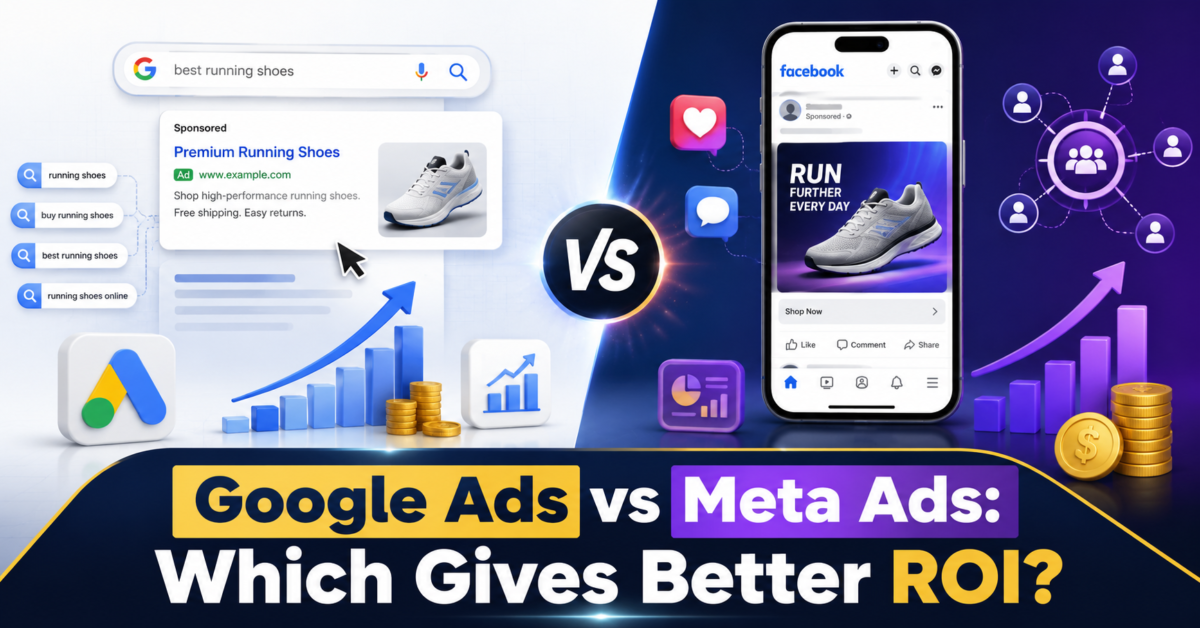
Businesses investing in digital advertising usually face one important question: should they spend their budget on Google Ads or Meta Ads?
Both platforms can generate leads, sales and measurable business growth. However, they work in very different ways. Google Ads generally connects businesses with people who are actively searching for a product or service. Meta Ads, which run across Facebook and Instagram, help businesses reach people based on their interests, behaviour and demographics—even when they are not actively searching.
So, in the debate between Google Ads vs Meta Ads, which platform actually provides a better return on investment?
The answer depends on your business model, target audience, advertising objective, budget and the stage of the customer journey you want to influence.
Understanding Google Ads
Google Ads is an intent-based advertising platform. It allows businesses to show advertisements when users search for relevant products, services or information.
For example, someone searching for “best web development company in Kolkata” is already expressing a clear requirement. A web development agency bidding on that keyword has an opportunity to reach the potential customer at the exact moment they are looking for assistance.
Google Search campaigns can be used to generate sales, leads and website traffic by reaching people who are actively searching for specific products or services. Google Ads Help
Google Ads offers several campaign types, including:
- Search campaigns
- Display campaigns
- Shopping campaigns
- Video campaigns
- App campaigns
- Demand Gen campaigns
- Performance Max campaigns
Performance Max campaigns can also place advertisements across Google Search, YouTube, Display, Discover, Gmail and Maps using a single goal-based campaign. Google Ads Help
Major Advantages of Google Ads
High Search Intent
Google Ads reaches users who are already searching for a solution. This usually makes Search campaigns particularly valuable for businesses offering services that people actively need.
Immediate Search Visibility
SEO can take time to generate strong organic rankings. Google Ads gives businesses an opportunity to appear prominently for selected searches as soon as an eligible campaign begins running.
Strong Keyword Control
Advertisers can select keywords, use negative keywords, control geographical targeting and adjust bids according to their objectives.
Suitable for Urgent Services
Google Ads can work well for services where customers need an immediate solution, such as:
- Emergency repair services
- Healthcare appointments
- Legal assistance
- Property enquiries
- Home services
- Local professional services
- B2B software requirements
Measurable Conversions
Google Ads allows businesses to define valuable actions such as purchases, enquiries, registrations and phone calls as conversions. Google Ads Help
Understanding Meta Ads
Meta Ads allow businesses to advertise across Facebook, Instagram, Messenger and other eligible Meta placements.
Unlike Google Search Ads, Meta Ads usually do not depend on users actively searching for a particular service. Instead, advertisers reach people using factors such as interests, demographics, location, previous interactions and behavioural signals.
Meta provides campaign objectives that include awareness, traffic, engagement, leads, app promotion and sales. Meta Business Help Center
This makes Meta Ads especially effective for visually appealing products, audience discovery, brand awareness and demand generation.
Major Advantages of Meta Ads
Strong Visual Storytelling
Meta supports engaging image, video, carousel and Reels advertisements. Businesses can demonstrate their products, explain their services and build emotional connections through creative storytelling.
Detailed Audience Targeting
Businesses can reach audiences based on relevant characteristics and optimise campaigns around specific advertising objectives.
Effective for Building Demand
A potential customer may not search for a new clothing brand, interior designer, restaurant or fitness programme. However, an attractive Facebook or Instagram advertisement can introduce the offering and create interest.
Lead Generation Within Meta
Meta’s lead objective allows businesses to find potential customers and collect enquiries. Meta Business Help Center
Instant forms can also reduce the number of steps users need to complete before submitting their information.
Retargeting Opportunities
Businesses can reconnect with people who have previously visited their website, interacted with social content or engaged with advertisements.
Google Ads vs Meta Ads: Key Differences
| Comparison Area | Google Ads | Meta Ads |
|---|---|---|
| Primary targeting approach | Search intent and audience signals | Interests, behaviour and audience signals |
| Customer mindset | Often actively looking for a solution | Often browsing or discovering content |
| Best suited for | High-intent leads and direct demand | Awareness, discovery and visual engagement |
| Main creative formats | Text, product, image and video ads | Images, videos, carousels, Stories and Reels |
| Typical customer journey | Captures existing demand | Creates and nurtures demand |
| Keyword targeting | Strong keyword-based Search options | No traditional search-keyword bidding |
| Visual storytelling | Available but not always central | A major platform strength |
| Lead generation | Landing pages, calls and lead forms | Websites, messages and instant forms |
| Remarketing | Available | Available |
| ROI potential | Strong when search intent is high | Strong when creative and audience targeting work together |
Which Platform Generates Better-Quality Leads?
When comparing Google Ads vs Meta Ads, lead quality is often one of the biggest concerns.
Google Search Ads may generate stronger high-intent leads because users are actively searching for a service. Someone searching for “commercial solar panel installation” or “hire a Laravel developer” is more likely to have an immediate requirement.
Meta Ads may generate a larger volume of enquiries at a lower initial cost in some campaigns. However, not every enquiry will necessarily have the same level of purchasing intent.
That does not mean Meta leads are automatically lower quality. Lead quality depends on:
- The campaign objective
- Audience targeting
- Advertisement copy
- Creative quality
- Offer relevance
- Form questions
- Landing-page experience
- Lead follow-up process
- Conversion tracking
A well-structured Meta campaign with qualifying questions and fast follow-up can produce valuable customers. Similarly, a poorly targeted Google Ads campaign can attract irrelevant clicks and waste money.
Which Platform Is More Cost-Effective?
There is no universal answer because advertising costs vary according to industry, competition, location, audience size, placement and campaign quality.
Google Search clicks can become expensive in competitive sectors because several businesses may bid for the same high-value keywords. However, a higher cost per click may still be profitable when the searcher has strong buying intent.
Meta Ads can sometimes provide broader reach and lower-cost engagement, but reach alone does not guarantee revenue. A campaign can attract thousands of views without producing meaningful enquiries if the creative, offer or targeting is weak.
Cost-effectiveness should therefore be evaluated using business outcomes rather than only cost per click.
Important metrics include:
- Cost per qualified lead
- Customer acquisition cost
- Conversion rate
- Average order value
- Lead-to-sale rate
- Revenue generated
- Return on ad spend
- Customer lifetime value
Google Ads vs Meta Ads for Different Business Types
Local Service Businesses
Google Ads is often a strong starting point for dentists, electricians, lawyers, repair companies, clinics and local consultants because customers frequently search when they need these services.
Meta Ads can support these businesses through local awareness, promotional campaigns, customer testimonials and retargeting.
E-commerce Businesses
Meta Ads can introduce products through attractive videos, lifestyle images, carousels and Reels. This makes the platform useful for fashion, beauty, accessories, home décor and other visually driven categories.
Google Shopping, Search and Performance Max campaigns can capture users who are actively comparing or searching for products.
For many e-commerce businesses, using both platforms provides better coverage across the purchasing journey.
B2B Companies
Google Ads can perform well when business customers search for specific solutions such as CRM software, industrial equipment, development services or corporate consulting.
Meta Ads may support B2B campaigns through brand awareness, educational content, retargeting and founder-focused messaging. However, targeting and lead qualification require careful planning.
Real Estate
Google Ads can capture searches related to specific locations, property types and buying requirements.
Meta Ads can present projects through videos, walkthroughs, amenities, lifestyle visuals and lead forms. Real estate advertisers may therefore benefit from using Meta for discovery and Google for high-intent enquiries.
Restaurants, Events and Lifestyle Brands
Meta Ads are generally well suited to visually driven promotions, new launches, special events, food imagery and local engagement.
Google Ads can still be valuable for location-based searches such as “restaurant near me,” event searches and branded queries.
High-Ticket Professional Services
For services such as software development, legal consulting, premium real estate or business consulting, Google Ads may capture stronger initial intent.
Meta Ads can build familiarity through educational videos, case studies, client testimonials and retargeting before the customer makes an enquiry.
When Google Ads May Provide Better ROI
Google Ads may provide better ROI when:
- Customers actively search for your service
- Your business solves an urgent problem
- You target high-intent commercial keywords
- Your landing page is designed for conversion
- Your sales team responds quickly
- The value of each customer justifies the advertising cost
- Conversion and call tracking are configured correctly
- Your campaign excludes irrelevant search terms
Google Ads conversion measurement can track actions users take after interacting with an advertisement. Accurate tracking is essential for understanding campaign performance and improving bidding decisions. Google Ads Help
When Meta Ads May Provide Better ROI
Meta Ads may provide better ROI when:
- Your product is visually appealing
- Customers need to discover your brand before searching
- Your objective is awareness or audience building
- Short-form video can demonstrate the product effectively
- You have strong offers and engaging creatives
- You want to generate enquiries through instant forms or messages
- You have enough creative variations for testing
- You want to retarget engaged users
Meta’s sales objective is designed for campaigns that seek people who are likely to purchase a product or service. Meta Business Help Center
Why Tracking Matters More Than the Platform
Businesses sometimes declare that Google Ads or Meta Ads “does not work” after running a campaign for a short period. In many cases, the real issue is incomplete tracking.
If a business tracks only clicks but not qualified enquiries, sales or revenue, it cannot accurately measure ROI.
A proper measurement system should ideally connect:
- Advertisement clicks or views
- Website visits or form submissions
- Phone calls and messages
- Qualified leads
- Confirmed customers
- Revenue generated
Google supports website conversion tracking, call tracking and offline conversion imports. Enhanced conversions can also use hashed first-party customer information to improve measurement accuracy. Google Ads Help
Businesses should also ensure that Meta campaigns are connected to the appropriate tracking and customer-management systems wherever possible.
Should You Use Google Ads and Meta Ads Together?
For many businesses, the best strategy is not choosing one platform and ignoring the other. Google Ads and Meta Ads can support different stages of the same customer journey.
A potential customer may:
- See your video on Instagram
- Visit your website
- Leave without making an enquiry
- Search for your service on Google later
- Click a Search Ad
- Return to your website
- Submit an enquiry
In this situation, Meta helped create awareness while Google captured the later search intent.
A combined strategy may look like this:
- Use Meta Ads to introduce the brand and create demand
- Use Google Search Ads to capture high-intent searches
- Retarget website visitors and engaged users
- Test separate offers for cold and warm audiences
- Measure qualified leads and sales across both platforms
- Allocate more budget according to profitable results
Common Mistakes That Reduce Advertising ROI
Regardless of the platform, the following mistakes can reduce returns:
- Running campaigns without conversion tracking
- Sending all traffic to the homepage
- Using a slow or confusing landing page
- Targeting an audience that is too broad or too narrow
- Ignoring negative keywords in Google Ads
- Using one creative for too long on Meta
- Optimising for clicks instead of meaningful conversions
- Failing to qualify leads
- Responding to enquiries too slowly
- Judging performance after only a few days
- Comparing platforms using different attribution methods
Google Ads vs Meta Ads: Which Gives Better ROI?
Google Ads may deliver better ROI when customers are already searching for a specific solution and the business can convert that intent into a sale.
Meta Ads may deliver better ROI when a business needs to create awareness, demonstrate a visually appealing product, reach new audiences or generate demand before people begin searching.
The practical verdict is:
- Choose Google Ads for high-intent search demand.
- Choose Meta Ads for discovery, visual storytelling and audience development.
- Use both platforms when you want to reach customers throughout the complete buying journey.
The platform alone does not determine ROI. Strategy, creative quality, targeting, offer, landing-page experience, measurement and follow-up all influence the final result.
Frequently Asked Questions
Is Google Ads better than Meta Ads?
Google Ads may be better for capturing users who are actively searching for a product or service. Meta Ads may be better for brand discovery, visual promotion and audience building.
Which platform is better for lead generation?
Google Ads can generate high-intent leads, while Meta Ads can generate leads through forms, messages and visually engaging campaigns. The better option depends on the business and campaign structure.
Is Meta Ads cheaper than Google Ads?
Meta Ads may sometimes offer lower costs for reach, engagement or initial enquiries. However, businesses should compare qualified-lead costs and sales rather than only click costs.
Which is better for small businesses?
Local service businesses may begin with Google Search Ads when customers actively search for their services. Visually driven or lifestyle businesses may find Meta Ads more suitable for initial promotion.
Can Google Ads and Meta Ads work together?
Yes. Meta Ads can generate awareness, while Google Ads captures people when they later search for a relevant solution.
How should advertising ROI be calculated?
A basic ROI calculation is:
ROI = (Revenue attributed to advertising − Advertising cost) ÷ Advertising cost × 100
Businesses should include advertising spend, agency fees, creative production and other relevant campaign costs where appropriate.
How long should campaigns run before evaluating performance?
Campaigns need enough time and conversion data to produce a meaningful evaluation. The appropriate duration depends on budget, sales cycle, conversion volume and campaign type.
Final Thoughts
The Google Ads vs Meta Ads decision should begin with customer behaviour.
If people already search for your offering, Google Ads can help you capture that demand. If your audience needs to discover, understand or become interested in your offering, Meta Ads can help create that demand.
For many growing businesses, the strongest approach is a coordinated strategy that uses Meta for awareness and engagement, Google for search intent, and accurate tracking to identify which campaigns generate qualified leads and profitable customers.
Need help selecting the right advertising platform? Start with a professional campaign audit, define your conversion goals and build a strategy based on measurable business outcomes—not clicks alone.
