

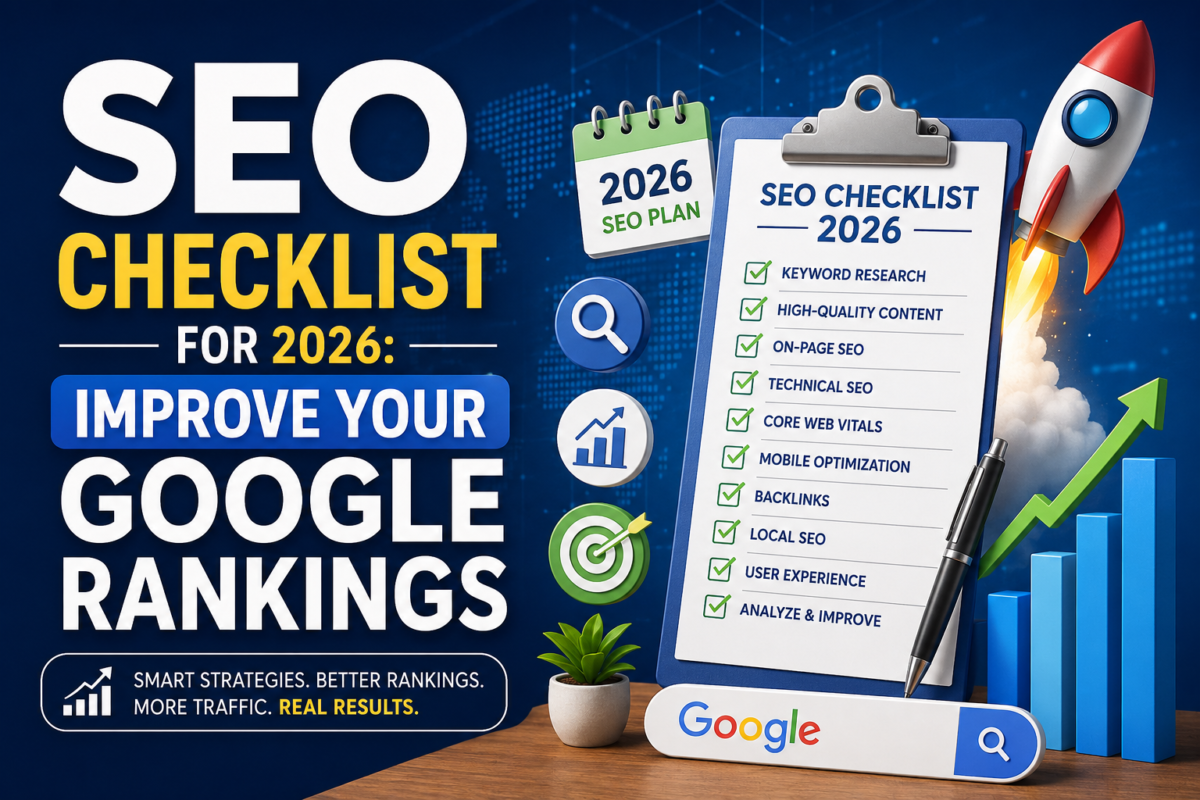
Search Engine Optimization (SEO) continues to evolve every year, and 2026 is no exception. Google’s AI-powered search experience, user-focused ranking signals, and evolving search algorithms mean businesses must stay ahead of the competition.
Whether you own a local business, an eCommerce store, or a corporate website, following the latest SEO best practices can significantly improve your visibility, drive organic traffic, and increase conversions.
Here’s the complete SEO Checklist for 2026 to help you dominate Google Search.
1. Optimize for AI Search & Google’s Search Generative Experience (SGE)
Google is becoming more AI-driven than ever before. Instead of simply ranking webpages, Google now generates AI-powered answers using high-quality content.
Best Practices
- Answer user questions directly.
- Create detailed, authoritative content.
- Add FAQs.
- Use structured headings (H2, H3).
- Include statistics and real examples.
- Focus on topical authority.
2. Perform Advanced Keyword Research
Don’t just target high-volume keywords.
Focus on:
- Long-tail keywords
- Question-based keywords
- Conversational search terms
- Local keywords
- Voice search queries
Recommended Tools
- Google Keyword Planner
- Ahrefs
- SEMrush
- Ubersuggest
- Google Search Console
3. Publish Helpful, High-Quality Content
Google rewards websites that genuinely help users.
Your content should be:
✔ Original
✔ Detailed
✔ Well-structured
✔ Updated regularly
✔ Human-friendly
Instead of writing 500-word articles, aim for 1500–3000+ words that comprehensively cover the topic.
4. Improve Core Web Vitals
Website speed remains a major ranking factor.
Focus on:
- Fast page loading
- Image optimization
- Lazy loading
- Browser caching
- CSS & JavaScript minification
- CDN implementation
Ideal metrics:
- Largest Contentful Paint (LCP): under 2.5 seconds
- Interaction to Next Paint (INP): under 200 ms
- Cumulative Layout Shift (CLS): below 0.1
5. Mobile-First Optimization
Over 70% of web traffic comes from mobile devices.
Ensure your website:
- Loads quickly
- Is fully responsive
- Uses readable fonts
- Has easy navigation
- Features clickable buttons
Google primarily indexes the mobile version of your website.
6. Strengthen On-Page SEO
Every page should include:
- SEO-friendly URL
- Optimized title tag
- Meta description
- H1 heading
- Internal links
- External authority links
- Image ALT text
- Keyword placement
Avoid keyword stuffing and prioritize natural readability.
7. Use Schema Markup
Structured data helps Google better understand your content and can improve search visibility.
Implement:
- Organization Schema
- Article Schema
- FAQ Schema
- Breadcrumb Schema
- Local Business Schema
- Product Schema
- Review Schema
8. Build High-Quality Backlinks
Backlinks remain one of the strongest ranking signals.
Effective strategies include:
- Guest posting
- Digital PR
- HARO (Help a Reporter Out)
- Industry directories
- Resource page outreach
- Creating shareable content
Avoid spammy or low-quality links.
9. Optimize for Local SEO
If you serve a local market, optimize for location-based searches.
Key steps:
- Optimize your Google Business Profile
- Collect customer reviews
- Maintain consistent NAP (Name, Address, Phone)
- Build local citations
- Create location-specific landing pages
10. Improve User Experience (UX)
Google values websites that provide an excellent user experience.
Enhance UX by:
- Simplifying navigation
- Improving readability
- Reducing intrusive pop-ups
- Adding clear calls-to-action (CTAs)
- Keeping visitors engaged with multimedia
A better user experience can reduce bounce rates and increase conversions.
11. Optimize Images
Large images can slow down your site.
Best practices:
- Use WebP format
- Compress images
- Add descriptive ALT tags
- Use lazy loading
- Include keyword-rich filenames
12. Create Internal Linking
Internal links help Google discover and understand your website.
Benefits:
- Pass link authority
- Improve crawlability
- Increase page views
- Help users navigate easily
Every important page should have multiple relevant internal links.
13. Monitor Technical SEO
Regularly check for:
- Broken links
- Redirect chains
- Duplicate content
- Crawl errors
- XML Sitemap
- Robots.txt
- Canonical tags
- HTTPS security
Technical SEO ensures search engines can crawl and index your site efficiently.
14. Optimize for Voice Search
Voice searches continue to rise with smart assistants.
Use:
- Conversational phrases
- Question-based headings
- FAQ sections
- Natural language
- Local intent keywords
Example:
Instead of:
SEO Company Kolkata
Use:
Which is the best SEO company in Kolkata?
15. Track SEO Performance
Use analytics tools to measure your SEO success.
Monitor:
- Organic traffic
- Keyword rankings
- Bounce rate
- Click-through rate (CTR)
- Conversions
- Backlinks
- Core Web Vitals
Essential tools:
- Google Analytics 4 (GA4)
- Google Search Console
- Ahrefs
- SEMrush
- Screaming Frog
Bonus Tips for SEO Success in 2026
- Regularly update older blog posts.
- Create topic clusters around your main services.
- Publish case studies and client success stories.
- Add videos and infographics to boost engagement.
- Optimize for featured snippets.
- Build trust with author bios and customer testimonials.
- Maintain a secure (HTTPS) website.
- Stay informed about Google algorithm updates.
Final Thoughts
SEO in 2026 is no longer just about keywords—it’s about delivering exceptional value, providing a seamless user experience, and demonstrating expertise, authority, and trustworthiness. By following this comprehensive SEO checklist, you can enhance your website’s visibility, attract qualified traffic, and achieve sustainable growth in Google Search.
If you need expert assistance with SEO, website optimization, or digital marketing, Code of Dolphins is here to help. Our team specializes in modern SEO strategies that drive measurable results and help businesses succeed online.
Frequently Asked Questions (FAQs)
1. What is the most important SEO factor in 2026?
Creating helpful, user-focused content while ensuring excellent technical SEO, fast page speed, and a strong user experience.
2. How often should I update my website for SEO?
Review and update your content every 3–6 months to keep it fresh, accurate, and competitive.
3. Is AI-generated content good for SEO?
AI can assist with content creation, but the final content should be reviewed, refined, and enriched with human expertise to ensure quality and originality.
4. Why are Core Web Vitals important?
Core Web Vitals measure your site’s loading speed, responsiveness, and visual stability, all of which contribute to better rankings and improved user experience.
5. Can local businesses benefit from SEO?
Yes. Local SEO helps businesses appear in Google Maps and local search results, attracting nearby customers and increasing foot traffic.
